
Composite vs cast-iron manhole covers
The useful comparison is between two complete cover-and-frame assemblies for the same opening and location. Material choice influences handling and exposure, but neither composite nor cast iron removes the need to verify the product and installation.
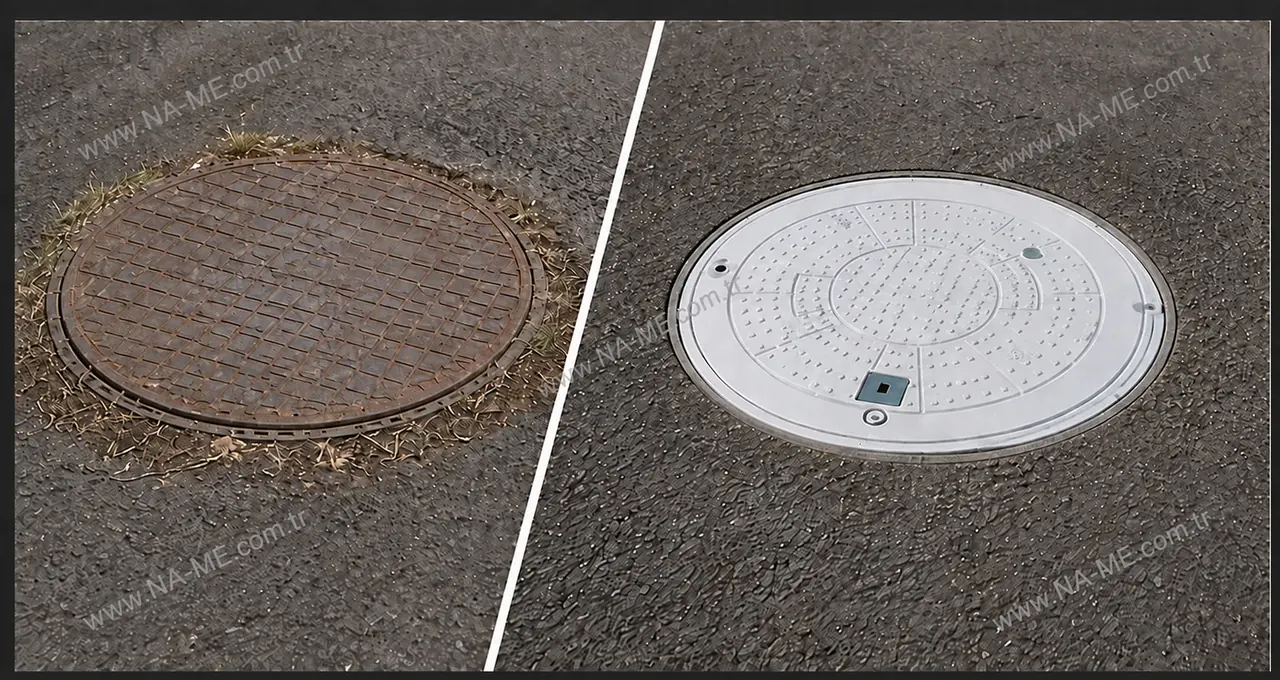
NA-ME illustration comparing metal and composite cover options.
Set a common comparison basis
Before comparing prices or weights, define the opening and the required installation performance. Both proposals should address the same clear opening, surrounding construction, traffic location and access needs. A lower-priced option may otherwise represent a smaller usable opening, different frame depth or fewer included components. Record what is supplied with each assembly so the comparison is genuinely like for like.
Composite is a broad material description, while cast-iron products also have specific material and construction details. Ask each supplier to identify the product rather than treating a generic material label as a specification. Where a standard is required, request the applicable general and material-specific references and evidence for the selected assembly. The name of the material does not establish the load class, and the class alone does not answer every service question.
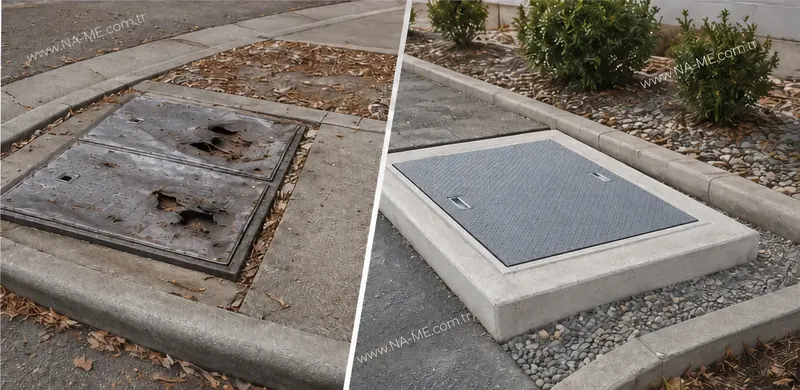
Illustrative material comparison; not a documented customer installation.
Compare the operational questions
| Question | Composite assembly | Cast-iron assembly |
|---|---|---|
| Handling | Confirm actual cover mass and lifting arrangement | Confirm actual cover mass and lifting arrangement |
| Exposure | Check resin and other components against the environment | Check iron, coatings and associated components against the environment |
| Fit | Verify cover, frame and seat as a matched system | Verify cover, frame and seat as a matched system |
| Performance | Request evidence for the exact composite construction | Request evidence for the exact iron construction |
| Security | Assess lock, restraint and access-control detail | Assess lock, restraint and access-control detail |
| Maintenance | Define inspection and replacement needs | Define inspection and replacement needs |
Assess handling as a task
Composite covers may offer handling advantages in suitable designs, but the actual mass and opening method are what the maintenance team needs. Ask whether access requires complete removal, a hinged opening or a lifting aid. Consider how the operator reaches the cover, where it is placed when open and how the opening is protected during work. These practical details can matter more than a broad statement that one material is lightweight.
For both materials, identify the correct lifting points and equipment. A lighter cover can still be awkward to handle because of its size, position or frequency of use. A heavier cover may need a planned mechanical method. Compare the full maintenance task, including closing and securing the cover, rather than assuming mass is a complete measure of effort or safety. Do not assign a manual-lifting limit from this guide.
Review exposure across every component
Composite selection requires compatibility between its construction and the operating environment. Cast-iron selection may require attention to corrosion and any protective system. For either assembly, seals, hinges, fasteners and locking parts have their own exposure conditions. A benefit in the main cover material should not obscure a vulnerable component that controls serviceability.
Describe standing water, process chemicals, cleaning, temperature and weather exposure. Note whether the chamber atmosphere differs from the surface environment. Ask how the proposed assembly should be inspected and what signs require action. Avoid requesting an unconditional corrosion-free or maintenance-free promise; instead, seek a material recommendation and care instructions linked to the stated conditions. If the site has a history of deterioration, provide the observed pattern and service history rather than assuming the new material automatically eliminates the cause.
Check frame compatibility and site work
A replacement cover should be assessed against the existing frame and support. Similar plan dimensions do not establish compatibility. Seat geometry, engagement, bearing and restraint can differ. If a new frame is required, include removal, chamber repairs, bedding and reinstatement in the comparison. These items can change the practical cost and disruption much more than the cover price.
For new construction, coordinate frame depth and finished levels with adjacent paving or roadway details. Confirm the proposed installation instructions and responsibilities. It is useful to compare assemblies at this stage because changes remain easier to accommodate. Once surrounding surfaces are complete, an apparently small dimensional difference can create additional work. Keep the agreed frame drawing with the purchase documentation so the site team receives the same geometry that was reviewed.
Separate security, sealing and service life
Security should be evaluated through the specific restraint or locking arrangement. A material’s scrap value is not a complete theft-prevention strategy, and a lighter cover may still need deliberate access control. Identify who needs to open the cover, which tools are required and how authorised access is maintained over time. Consider replacement keys or lifting tools as part of the operating arrangement.
Likewise, do not infer watertightness or odour control from material. State the required sealing function and ask how it is achieved by the assembly. For service-life comparisons, use the expected environment, maintenance activities and evidence available for the products. Avoid a universal lifetime figure or percentage saving. A transparent assessment can compare purchase, installation, inspection and replacement tasks even where long-term costs remain uncertain; mark those assumptions instead of presenting them as measured outcomes.
Make the purchasing decision traceable
A useful decision record identifies the application, the alternatives reviewed and the reasons for choosing one assembly. Include the dimensions, material description, performance evidence, handling arrangement, installation work and remaining limitations. This gives procurement and maintenance teams a shared basis for later orders and avoids substitutions based only on a familiar class marking.
For a NA-ME composite cover enquiry, provide the opening and frame requirements, quantity, destination and traffic description. If you are comparing against an existing iron assembly, describe it and identify the problem you want to solve. Ask for product-specific information for the proposed replacement. The EN 124 series has separate parts for different materials, so evidence should relate to the selected material and assembly rather than be transferred between alternatives. NA-ME composite covers are manufactured and classified to EN 124-5, the part for composite materials; the load class (B 125, C 250 or D 400) depends on the model and is confirmed for each line item in the quotation.